Mobile Game Subscriptions Nearly Doubled Revenue Share Most Studios Still Don't Offer One
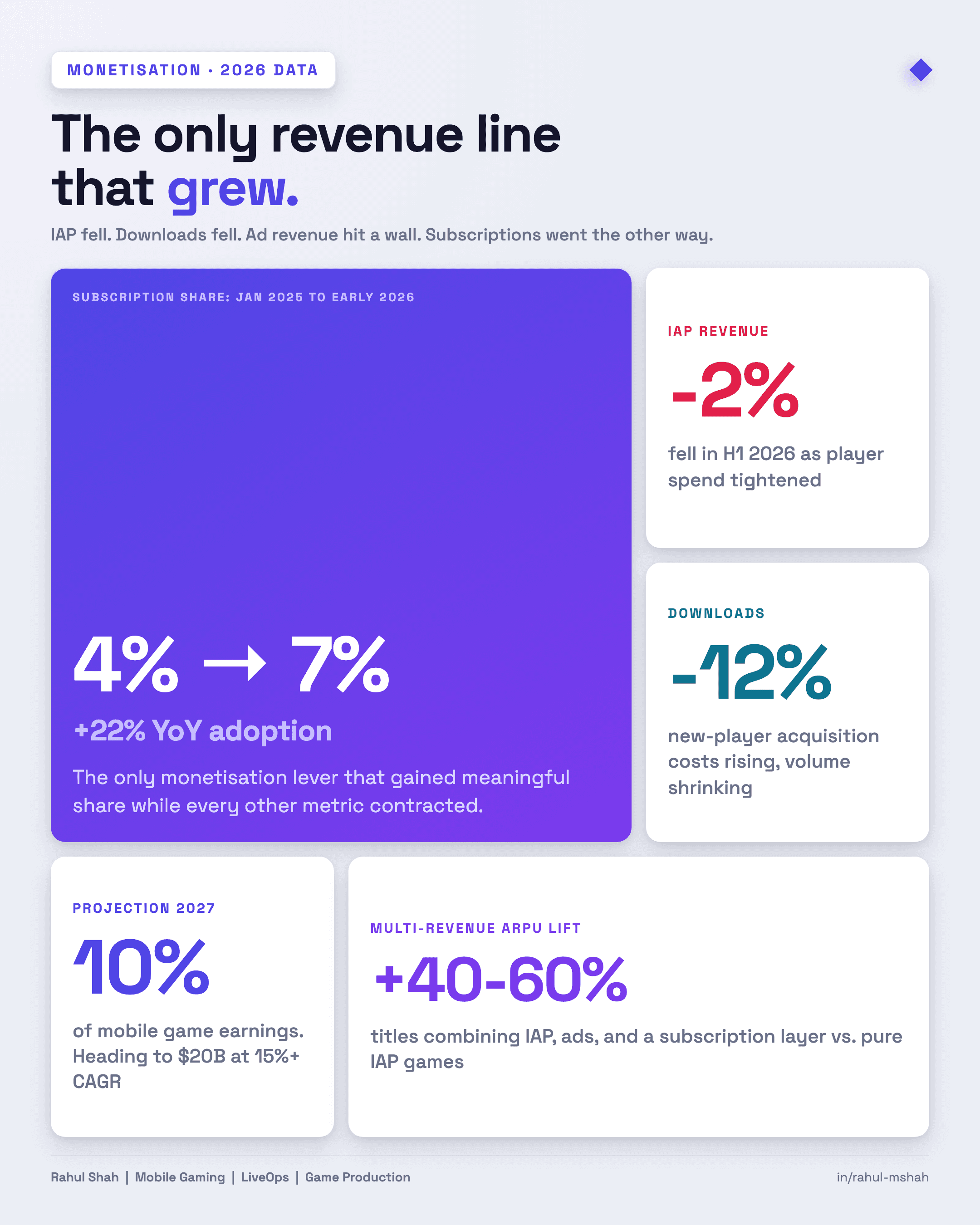
Between January 2025 and early 2026, mobile game subscriptions grew from 4% to nearly 7% of the total revenue mix. That's a 22% increase in adoption year over year, in a period where IAP revenue fell 2%, downloads dropped 12%, and ad revenue growth hit diminishing returns. Subscriptions are the only monetisation lever that gained meaningful share, and the majority of studios still don't have one.
The conventional explanation is that battle passes drove this growth. That's incomplete. The battle pass contribution is real, but the faster-growing segments are VIP memberships, cross-game passes, and monthly content bundles that sit outside the event calendar entirely. These models share a common trait: they convert the player from a per-transaction buyer into a recurring member, and that identity shift changes how the player interacts with every other monetisation surface in the game.
I've seen this play out firsthand. At Moonfrog, VIP tiers drive 40 to 50% of IAP revenue across our card franchise, Teen Patti Gold, but the tier fee itself is a small fraction of what those players actually spend. The tier changes the relationship: a VIP player opens the game expecting to see offers tailored to them, and they convert on event bundles, seasonal packs, and limited offers at rates that non-VIP players simply don't match. The subscription isn't the revenue; it's the mechanism that makes everything else convert better. Studios looking at the 7% share and concluding it's too small to prioritise are reading the wrong number. The right number is the 40 to 60% ARPU lift that multi-revenue model titles, combining IAP, ads, and a subscription layer, achieve over pure IAP titles.
The infrastructure question is real, though, and it explains why adoption is still this low. Subscriptions require an entitlements layer: logic that tracks what a subscriber has access to, gates content accordingly, handles renewals and cancellations and grace periods across iOS and Android, and serves exclusive content on a cadence that justifies the monthly fee. Most studios built their tech stack around one-time purchases and seasonal events. Bolting a subscription onto that stack is non-trivial, which is why the studios that have already invested in it have a structural advantage that widens every month.
Subscriptions are projected to hit 10% of mobile game earnings by 2027, heading toward $20 billion at 15%+ CAGR. The growth is coming from existing players in existing games, the most capital-efficient revenue lever in a market where downloads are shrinking and new-player acquisition costs more every quarter. Every month a studio delays is a month of recurring revenue it forfeits to the studios that moved first.
blog.udonis.co/mobile-marketing/mobile-games/mobile-gaming-statistics dualmedia.com/app-monetization-2026/